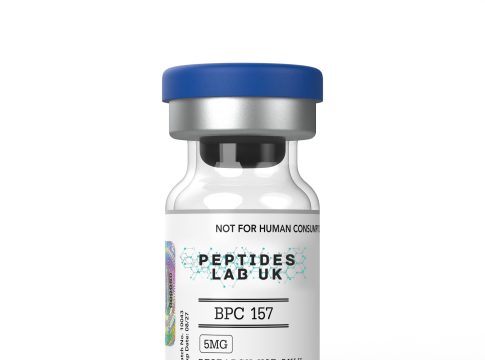
BPC-157 is a synthetic pentadecapeptide derived from a partial sequence of a human gastric juice protective protein. Its 15-amino-acid sequence has been studied extensively in preclinical models for its stability across a wide pH range and its role in soft tissue and mucosal repair signalling. Within laboratory research, BPC-157 peptides are used as a tool compound for investigating angiogenesis, cell migration and tissue-remodelling pathways in cell culture and animal-model systems. Because published research on the compound spans musculoskeletal, gastrointestinal and vascular models, it is frequently used as a comparative reference point across otherwise unrelated areas of tissue-repair research.
What Are BPC-157 Peptides?
BPC-157 (Body Protection Compound-157) consists of the 15-amino-acid sequence Gly-Glu-Pro-Pro-Pro-Gly-Lys-Pro-Ala-Asp-Asp-Ala-Gly-Leu-Val, with a molecular weight of approximately 1,419 Da. It is derived from a longer parent protein identified in human gastric juice, and the synthetic pentadecapeptide represents the biologically active fragment of that larger protective protein sequence.
A defining structural feature of BPC-157 is its stability under conditions that would degrade most other peptides, including the strongly acidic environment of the stomach at pH 2 to 3. This stability profile distinguishes it from many other research peptides, which typically require more careful pH control to avoid rapid degradation, and it is one of the reasons researchers have used BPC-157 as a reference compound when studying structure-stability relationships in short peptide sequences. Unstabilised fragments or partial sequences derived from the same parent protein do not reliably reproduce this stability profile, which is why researchers working with BPC-157 peptides should confirm the exact sequence and stability data supplied with a given batch rather than assuming equivalence across differently sourced material.
The peptide’s discovery and early characterisation work took place predominantly at the University of Zagreb, where researchers first isolated and sequenced the protective fragment from human gastric juice and began systematically testing its stability and biological activity across a range of experimental conditions. This origin as a naturally occurring gastric protein fragment, rather than a wholly synthetic or engineered sequence, is frequently cited in the literature as a possible explanation for its comparatively broad activity across multiple tissue types, since the parent protein appears to be involved in general mucosal protection rather than a single, narrowly defined physiological function.
Mechanism of Action
The most extensively documented mechanism associated with BPC-157 in the published literature is its effect on angiogenesis, the formation of new blood vessels from existing vasculature. A key study using human vascular endothelial cell culture and a rat hind-limb ischemia model reported that BPC-157 increased both mRNA and protein expression of vascular endothelial growth factor receptor 2 (VEGFR2), promoted VEGFR2 internalisation, and time-dependently activated the downstream VEGFR2-Akt-eNOS signalling cascade. This activation was associated with increased endothelial tube formation in vitro and accelerated blood flow recovery in the ischemic rat model, and the effect was blocked by dynasore, a pharmacological inhibitor of receptor endocytosis, supporting a receptor-internalisation-dependent mechanism.
Separately, BPC-157 has been studied for its interaction with the nitric oxide (NO) system, a pathway relevant to vascular tone regulation and tissue protection during injury. Research groups have reported that BPC-157 modulates NO system activity in a manner that appears to counteract both excessive vasoconstriction and excessive vasodilation, depending on the tissue context, a bidirectional modulatory pattern that has been proposed as a mechanism for its broad activity across different injury models. Some researchers have suggested that this bidirectional NO modulation may help explain reports of BPC-157 activity in models involving compromised vascular integrity, including models of induced thrombosis and models of bleeding associated with thrombocytopenia, although the precise molecular basis for switching between vasoconstrictive and vasodilatory modulation in different tissue contexts remains incompletely characterised.
A further mechanism relevant to soft tissue research is BPC-157’s reported effect on cell migration and proliferation pathways in fibroblast populations. In-vitro work using tendon fibroblasts has reported activation of the FAK-paxillin signalling pathway, which is associated with cell migration, alongside upregulation of growth hormone receptor expression in the same cell type, a finding that has been proposed as a mechanism by which BPC-157 may sensitise tendon fibroblasts to endogenous growth hormone signalling. Collagen synthesis signalling has also been examined in tendon and muscle repair models, where histological assessment has reported more organised collagen fibre deposition and improved fibroblast proliferation in BPC-157-treated tissue relative to controls. Together, these angiogenic, nitric-oxide-related and fibroblast-signalling mechanisms are generally described in the literature as acting in combination rather than through a single isolated pathway.
What the Research Shows
The foundational tendon study in this field was published by Staresinic and colleagues, who examined complete transection of the Achilles tendon in rats treated with BPC-157 or saline. The BPC-157-treated group showed improved biomechanical outcomes, including increased load to failure and Young’s modulus of elasticity, alongside superior histological organisation of collagen and fibroblasts compared with controls; a companion in-vitro assay in the same study also reported that BPC-157 directly stimulated tendocyte proliferation (Achilles tendon transection study).
The angiogenesis mechanism described above was characterised in detail in a study combining human vascular endothelial cell culture with a rat hind-limb ischemia model, which reported the VEGFR2-Akt-eNOS activation pathway discussed in the mechanism section and confirmed that the pro-angiogenic effect could be pharmacologically blocked at the level of receptor internalisation (VEGFR2 activation study).
A separate line of muscle-healing research examined complete transection of the quadriceps muscle in rats, reporting that systemic BPC-157 administration induced healing of an injury that does not spontaneously resolve in this model, with functional restoration maintained across a 72-day observation period (quadriceps muscle transection study).
Additional preclinical work has examined mucosal and vascular responses in gastric tissue models, consistent with BPC-157’s original identification as a gastric-derived protective peptide, and researchers have noted that the great majority of the published preclinical literature originates from a single research group based at the University of Zagreb, a concentration of authorship that is relevant context when appraising the overall evidence base and the current lack of independent replication across unaffiliated laboratories.
Separate in-vitro work examining tendon explant cultures has reported that BPC-157 significantly accelerates outgrowth of tendon fibroblasts from cultured explants and increases their migration in a dose-dependent manner under transwell filter migration assays, although the same study found that BPC-157 did not directly increase proliferation of cultured tendon fibroblasts as measured by a standard MTT viability assay, indicating that its effect on tendon healing in vivo may depend more heavily on cell migration and survival under oxidative stress than on direct mitogenic activity. This distinction between migration-driven and proliferation-driven mechanisms is a recurring theme across the tendon and ligament research literature and is relevant to researchers designing in-vitro assays intended to model specific aspects of the in-vivo healing response.
Research Applications
Within laboratory settings, BPC-157 peptides are used across several established research contexts. Soft tissue healing models represent the most extensively studied application, where BPC-157 is administered to rodents following surgical transection of tendon, ligament or muscle tissue, with outcomes assessed through biomechanical testing, functional indices and histological analysis of collagen organisation and fibroblast activity. Gastrointestinal mucosal permeability assays constitute a second major research context, reflecting BPC-157’s origin as a gastric-derived peptide, where researchers examine its effects on mucosal integrity and healing in models of induced gastric or intestinal injury.
Cellular proliferation protocols using isolated fibroblast or endothelial cell cultures are also common, allowing researchers to isolate specific signalling effects, such as VEGFR2 pathway activation or FAK-paxillin-mediated migration, from the more complex physiological context of an intact animal model. Comparative pharmacology studies represent a further application, in which BPC-157 is examined alongside other tissue-repair peptides, such as thymosin beta-4-derived compounds, to characterise differences in mechanism, with BPC-157’s angiogenic and NO-modulating activity generally distinguished from the actin-regulatory mechanisms studied for other repair-associated peptides. When selecting a certified BPC-157 research peptide for cell culture or tissue interaction assays, researchers should confirm the exact amino acid sequence and purity documentation supplied, since minor sequence variation or degradation can materially affect the reproducibility of angiogenesis and cell-migration assay outcomes.
Purity, Storage and Handling
Research-grade BPC-157 should be accompanied by a certificate of analysis confirming purity by HPLC, typically at or above 98 percent, together with mass spectrometry verification confirming the correct 15-amino-acid sequence and molecular weight. Because much of the published research literature relies on a specific, well-characterised sequence, even minor synthesis variation can affect whether experimental findings from the literature are reproducible with a given batch. When evaluating high-purity BPC-157 peptides for laboratory research, UK researchers should verify that each batch includes this documentation rather than relying on a generic product listing.
Lyophilised BPC-157 is reported to remain stable when stored at -20°C for extended periods, with some published handling data suggesting stability of up to 24 months under appropriate lyophilised storage conditions. Once reconstituted, however, stability is more limited, and reconstituted solutions should be refrigerated at 2-8°C and used within the supplier’s stated stability window. Buffer choice for reconstitution should account for BPC-157’s documented stability across a wide pH range, though researchers should still follow the specific reconstitution guidance provided with each batch rather than assuming that acid stability alone eliminates the need for appropriate buffer selection and light-protected storage.
Frequently Asked Questions
What is the amino acid sequence of BPC-157?
BPC-157 consists of the 15-amino-acid sequence Gly-Glu-Pro-Pro-Pro-Gly-Lys-Pro-Ala-Asp-Asp-Ala-Gly-Leu-Val, with a molecular weight of approximately 1,419 Da. It is derived from a longer gastric protective protein identified in human gastric juice.
Why is BPC-157 described as unusually stable compared with other research peptides?
Published data indicates that BPC-157 retains biological activity across a wide pH range, including highly acidic conditions similar to gastric acid, a property not shared by most short peptide sequences, which generally require narrower pH control to avoid degradation. This stability has made it a useful reference compound in comparative peptide-stability research.
What mechanism explains BPC-157’s angiogenic research findings?
Preclinical studies report that BPC-157 upregulates VEGFR2 expression and promotes its internalisation in endothelial cells, activating the downstream VEGFR2-Akt-eNOS signalling pathway. This mechanism has been demonstrated in both cell culture and rat ischemia models, with the effect shown to be blockable using pharmacological inhibitors of receptor endocytosis.
How should research-grade BPC-157 be verified before use in an assay?
Researchers should request a batch-specific certificate of analysis confirming HPLC purity of 98 percent or higher and mass spectrometry confirmation of the correct 15-amino-acid sequence, since sequence accuracy is central to reproducing angiogenesis and tissue-repair assay findings reported in the literature.
BPC-157 peptides, as supplied by Peptides Lab UK and comparable UK research suppliers, are intended strictly for in-vitro and animal-model laboratory research. They are not licensed or intended for human or veterinary use, and nothing in this article should be interpreted as guidance for personal administration.