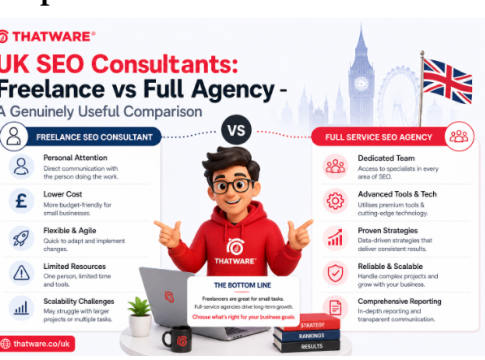
At some point, almost every UK business doing SEO seriously has to make this decision: go with an independent consultant or engage a full agency. The advice you get on this question tends to be biased by who you ask – consultants emphasize the personal attention and expertise access, agencies emphasize team depth and operational scale. Neither is entirely wrong. Both are selling something.
When a UK SEO Consultant Is the Right Call
Start with what you actually need. For most small and medium UK businesses with a focused SEO challenge – a specific set of keywords to crack, a technical audit to work through, a content strategy to develop – an experienced independent consultant often delivers better value. You’re buying direct access to senior expertise without the overhead of an agency model. A good uk seo consultants professional who knows your industry can often diagnose and address your specific problem faster and more precisely than a full agency that needs to staff a team, build internal context, and route work through account management layers.
When a Full UK SEO Company Makes More Sense
The agency model starts to make more sense at scale. If you’re running an enterprise site with thousands of indexed pages, producing content across multiple categories, managing link building campaigns, and need regular technical monitoring – you need a team, not a person. Even the best independent consultant has bandwidth limits. There’s only so much they can personally produce and oversee.
For growth-stage companies or enterprises, a uk seo company with a proper team – dedicated content, technical, and strategy functions – provides the operational capacity to run SEO as a significant channel rather than a limited program.
Evaluating Quality Before You Commit
The quality variable is the hardest to evaluate before committing. In the consulting world, quality is very personal – entirely dependent on the specific individual. If they get ill, take a holiday, or take on too many clients, your work is directly affected.
Agencies distribute that risk but create a different kind of opacity. The pitch is usually delivered by senior staff who won’t be doing the day-to-day work. Asking specifically to meet the people who will execute your work – not just the business development team – is one of the most useful things you can do before signing a UK agency contract.
Understanding What You’re Actually Paying For
Pricing structures differ in ways that aren’t just about rate. Consultants typically charge day rates or monthly retainers with a defined scope of hours. Agencies often bundle their pricing in ways that make it harder to understand what you’re paying for – account management, reporting overhead, and internal coordination can represent a significant portion of the fee.
Neither structure is inherently better. But understanding what you’re actually paying for helps you evaluate whether you’re getting it.
The Middle Path Most UK Businesses Settle On
A middle path that many UK businesses settle on: use an independent consultant for strategy and oversight, and supplement with specialist execution support – a content team, a technical developer, a link building resource – either in-house or through flexible specialist agencies. This captures the senior expertise access of the consultant model while addressing the scale limitations.
The honest answer to freelance vs agency is: it depends on your current constraints more than anything else. Scope, budget, internal capacity, and how much strategic versus tactical support you actually need. The best choice is usually the one most